

Looking to get your plantar warts treated, or unsure if your skin complaint is a plantar wart?
Our highly experienced team is here to help you get the right treatment, from diagnosis to removal.
Warts are a noncancerous growth caused by a viral infection that enters the body through breaks in the skin. A plantar wart is the same as any other wart – the term “plantar” simply refers to it being on the bottom of the foot.
Most people expect warts to have a raised surface, but plantar warts are a little different. They appear as flat lesions, as pressure from being walked on pushes them into the skin.
Plantar warts typically form on the parts of the foot that have the most direct contact with the ground: the balls and heels of the foot. Sometimes, plantar warts can appear in clusters called mosaic warts.
The group of wart-causing viruses in humans is called Human Papillomavirus (HPV). Plantar warts can occur when HPV invades the body through tiny cuts or breaks in the skin on the bottom of the feet.
Once you have one plantar wart, it’s possible for it to spread to others, and for the warts to multiply on your own foot.
While any foot can develop plantar warts, certain people are at a higher risk of developing them. Being aware of what causes plantar warts can help you prevent them. Here’s what contributes to an increased risk of plantar warts:
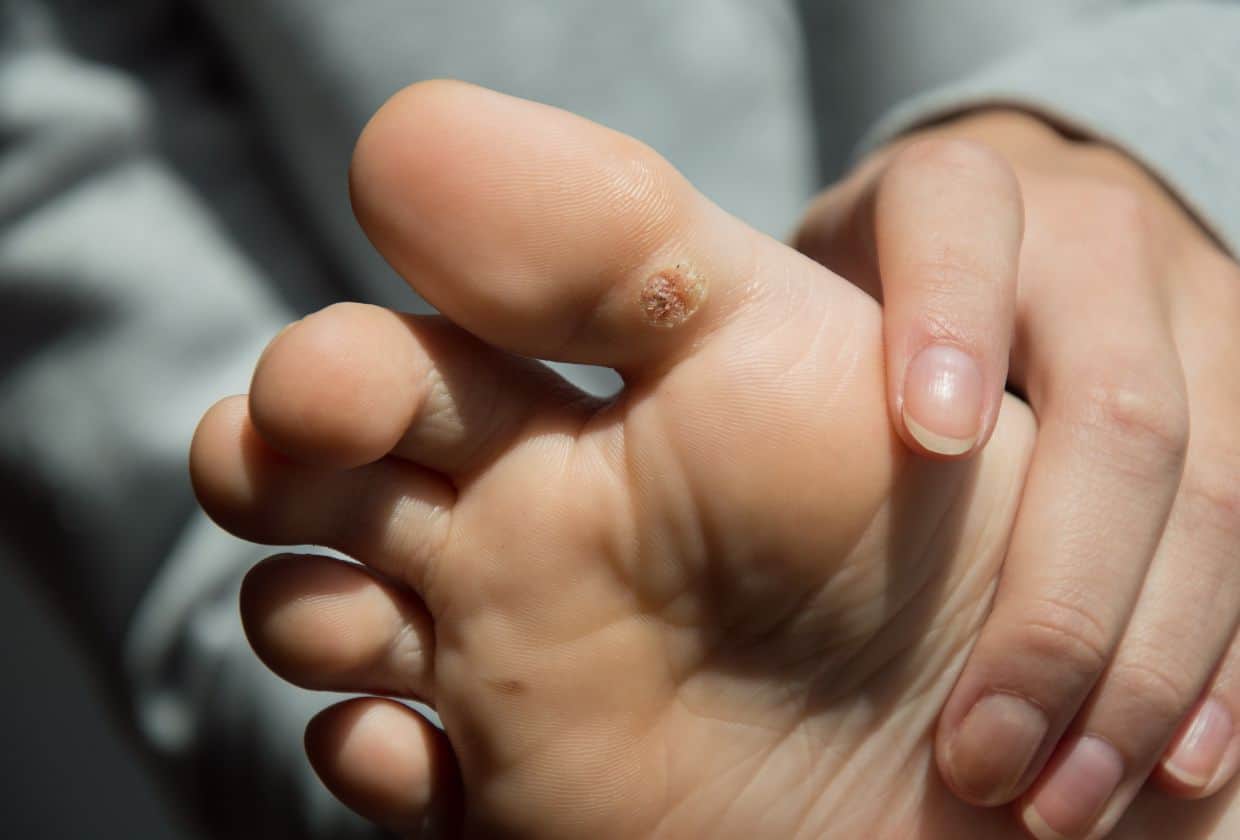
What does a plantar wart look like? How can you identify them? While your podiatrist can diagnose or confirm the diagnosis, here are the signs to watch out for:
Your podiatrist will be able to tell you if you’ve got plantar warts. This might involve inspecting the area or removing a small part of the thickened skin to check for the characteristic black dots that often appear on plantar warts.
In some rare cases, a biopsy may be needed to rule out other diagnoses or to test for the presence of HPV.
While Plantar warts may eventually clear up on their own, most patients desire faster relief.
There are plenty of treatment options available – your podiatrist will help you identify the right one for you.
This may seem very counterintuitive, but often a very effective way to clear a wart is to give it some time. Within 2 years, most plantar warts will disappear naturally as your body’s immune system detects and fights off the virus.
Pros
Cons
One of the common plantar wart treatments is the application of salicylic acid. Salicylic acid is an ingredient found in most topical wart treatments available commercially. It works to chemically debride (remove) the infected wart tissue and, as a result, triggers an inflammatory immune response. If you see a podiatrist, they will be able to safely apply a much stronger formulation than one that you can buy and apply yourself at home.
Pros
Cons
Another of the common plantar wart treatments is cryotherapy. Cryotherapy involves applying concentrated liquid nitrogen to apply extreme cold to the wart tissue. Similar to salicylic acid treatment, cryotherapy treatment will work to destroy the wart tissue and trigger the body’s immune response to the virus. This type of treatment is the go-to treatment for most GPs in treating warts of all kinds.
Pros
Cons
This option is usually considered for stubborn plantar warts and mosaic warts. The multi-puncture technique is done under local anaesthesia. It involves using a thin surgical needle to puncture the wart tissue repeatedly. This creates a ‘wound’ for the body to respond to and fight, and pushes the viral particles deep into the tissue where they are more easily detected.
Pros
Cons
SWIFT microwave therapy is a modern plantar wart treatment. It uses a concentrated set of microwaves that penetrate the wart tissue to a controlled depth. These microwaves generate a ‘heat shock’ reaction in the tissue, which stimulates the body’s immune and healing responses. With minimal side effects and aftercare, SWIFT is indicated for all warts, either as a first-line treatment or to treat large or stubborn plantar warts.
Pros
Cons
It’s common to experience a recurrence of plantar warts. Contagious parts of the skin might not be removed the first time, or a weakened immune system might prevent the body’s natural response from occurring.
Plantar warts develop as a result of broken skin coming into contact with the human papillomavirus, so it’s important to avoid contact with areas where it may be present. Wear shoes (or shower shoes) in areas including:
As always, you should follow all of your Podiatrist’s instructions, including all home care advice as well as follow-up visits.